


Latest
The Sustainable Development Goals in Liberia
The Sustainable Development Goals are a global call to action to end poverty, protect the earth’s environment and climate, and ensure that people everywhere can enjoy peace and prosperity. The UN in Liberia, the Government and Partners are ensuring that the 17 SDGs are achieved in Liberia although emphases are attached to those relevant to the country context.
Story
08 May 2025
UN Women Liberia Launches Renewed Civil Society Advisory Group (CSAG) 2025–2026
On 6th May 2025, UN Women Liberia officially launched the 2025–2026 Civil Society Advisory Group (CSAG) at the United Nations One House in Monrovia. The event, attended by the Honourable Gbeme Horace-Kollie, Liberia’s Minister of Gender, Children and Social Protection andUN Women Liberia Country Representative, Comfort Lamptey and Deputy Director of Civil Society Engagement from UN women HQ, alongside members of the newly appointed CSAG and UN Women Liberia Staff. The re-establishment of CSAG reaffirms UN Women’s commitment to inclusive dialogue and co-creation with civil society, particularly women’s rights organizations, youth groups, and community leaders. The CSAG brings together 12 distinguished members, selected for their diverse backgrounds and strong credentials in women’s rights and gender empowerment in Liberia. As an institutional mechanism, the CSAG serves as a strategic platform for regular dialogue between UN Women and leaders from civil society on key gender equality issues at national level ensuring that grassroots perspectives inform policies, programs, and advocacy on gender equality.In her remarks, Minister Horace-Kollie welcomed the revitalized CSAG, highlighting its role in fostering inclusive decision-making and deepening partnerships between government and civil society.Strategic Role in Advancing Gender EqualityOriginally established in 2016, the CSAG played an advisory role until 2019. Its renewal comes at a pivotal moment, aligned with the development of UN Women’s new Strategic Plan, Liberia’s Strategic Note, and global milestones such as the celebration for the 30th anniversary of the Beijing Platform for Action and the 15th anniversary of the establishment of UN Women. “The renewed CSAG will act as a powerful mechanism to integrate grassroots perspectives into strategic decision-making,” said Madam Comfort Lamptey, the UN Women Liberia Country Representative, adding, “By reactivating this group, UN Women is recommitting to ensuring civil society remains a core partner in our efforts to drive transformative change for women and girls in Liberia.”Over the next two years, the CSAG will advise UN Women Liberia on thematic priorities, contribute to strategic planning, and support coordinated advocacy with national stakeholders. Strengthening Partnerships and Civil Society EngagementThe launch introduced the new CSAG members to UN Women’s mandate and provided an opportunity to outline their advisory role, share programmatic highlights, and identify areas for collaboration. Best practices from global CSAGs were also shared to inspire effective engagement and strategic direction.UN Women Liberia has put in place a framework to guide CSAG engagement, aiming to integrate civil society input into policy discussions and ensure meaningful collaboration with government and other partners. This approach reaffirms UN Women’s commitment to inclusive governance and sustainable progress on women’s rights. UN Women expects a productive partnership with the CSAG, recognizing that this collaboration will strengthen advocacy efforts, enhance program effectiveness, and create more responsive interventions for women and girls across Liberia. By combining UN Women's technical expertise with CSAG's grassroots knowledge and community connections, this alliance promises to amplify voices that have been historically marginalized, foster greater accountability in gender-responsive initiatives, and accelerate progress toward gender equality objectives that benefit all sectors of Liberian society.
1 of 5

Story
17 March 2025
From School Speeches to Making a World Stage Statement
Mai Wiakanty’s eyes glistened with wonder as the sprawling silvery Manhattan skyline came into sight during the plane’s final descent, a stark contrast from the lush woodland savanna of her Liberian homeland. Her arrival at the airport marked the end of one journey and the beginning of another.It was her first time flying international waters. The eight-hour journey revealed the chasm between the land of departure and the land of arrival. Yet, despite the unfamiliar territory, she found comfort in the familiar feeling of simply being around people and listening to their stories.Just weeks before, the 16-year-old from Grand Gedeh County was convening members of the Zwedru Multilateral High School's Buddy Club. The next thing she knew, she was already on her way to the other side of the Atlantic, speaking alongside world leaders at the Summit of the Future, held on the sidelines of the 79th session of the UN General Assembly. The Summit of the Future is a high-level event where world leaders discuss solutions to pressing global issues and chart a course for the future.“I had never considered travelling outside my county to Monrovia, let alone flying to New York City, so that was a very memorable event for me. I even met and talked to the President and our county senator, which made me very proud,” Mai said.Mai’s journey to the Summit began when she was elected president of her school’s Buddy Club, a UNICEF-supported initiative led by children and adolescents working to end harmful behaviours like sex-for-grades, bullying, and corporal punishment.A UNICEF U-Report in 2015 highlighted a taboo issue in Liberia: teachers exploiting children by awarding grades in return for sex. In response, UNICEF partnered with the Ministries of Education and Gender, Children, and Social Protection to provide information, a helpline, and enhanced protection in schools.The Buddy Club is an extension of these ongoing efforts to create a safe learning environment, especially given recent issues like students struggling to maintain consistent attendance due to bullying.“The Buddy Club is, above all, about friendship and protecting each other,” Mai explained. “I have seen friends and schoolmates bullied for getting low grades. I noticed most feel shame, so our club tries to talk to them and encourage them not to give up. Bullying doesn’t mean they should stay away from school.”Mai doesn’t shy away from difficult conversations, a key part of her role. As president, she advises her peers to protect their mental health by ignoring negative comments and reporting serious issues they witness or experience, within and outside school, to the authorities. She also inspires them to build confidence and practise leadership by speaking before the club.These qualities propelled Mai to speak at the Summit of the Future on critical issues like peace, child rights, climate change, and digital literacy.“I spoke at one of the high-level discussions alongside President Joseph Nyuma Boakai Sr.,” Mai said. “We talked about advancing universal primary education and, in particular, rallied support to help street children return to school.”“I was happy to see and hear our government addressing the needs of Liberian children. Hearing firsthand what these people in power are planning for us and the next generation was a revelation. It was important to be part of that discussion. I hope more Liberian children are invited to these events,” she added.Mai was not alone on this journey. Joining her was Roberto R. Cooper Jr., the 16-year-old Speaker of the Liberia Children's Representative Forum. Together, they made history as Liberia became the only country to include child representatives at UNGA 79 and the Summit of the Future.Roberto and Mai’s journey demonstrated their passion and commitment to child rights. They engaged with global leaders, participated in discussions on climate change, peace, and digital literacy, and shared their experiences. Roberto, as a strong advocate for children’s inclusion in decision-making, emphasized the importance of allowing young people to be part of conversations shaping their future.At the Summit, Mai advocated for children in street situations and delivered a speech at the launch of a support project, highlighting the need for care, protection, and opportunities for vulnerable children. Roberto, in turn, reinforced the necessity of creating spaces where young voices are genuinely considered in national and global decision-making. Their participation underscored the importance of child participation in addressing pressing global challenges.Back home, Mai brings new lessons and experiences she eagerly plans to share with her peers. For her, this journey isn't just about herself but about fostering a culture of learning and building relationships, hoping they will follow in her footsteps after graduation.When asked about her plans, Mai’s eyes lit up. "University is just around the corner," she smiled. "Maybe I'll pursue a degree in economics or accounting, perhaps somewhere outside Liberia. I think I could get used to travelling for the sake of learning.” Source: UNICEF
1 of 5
Story
03 March 2025
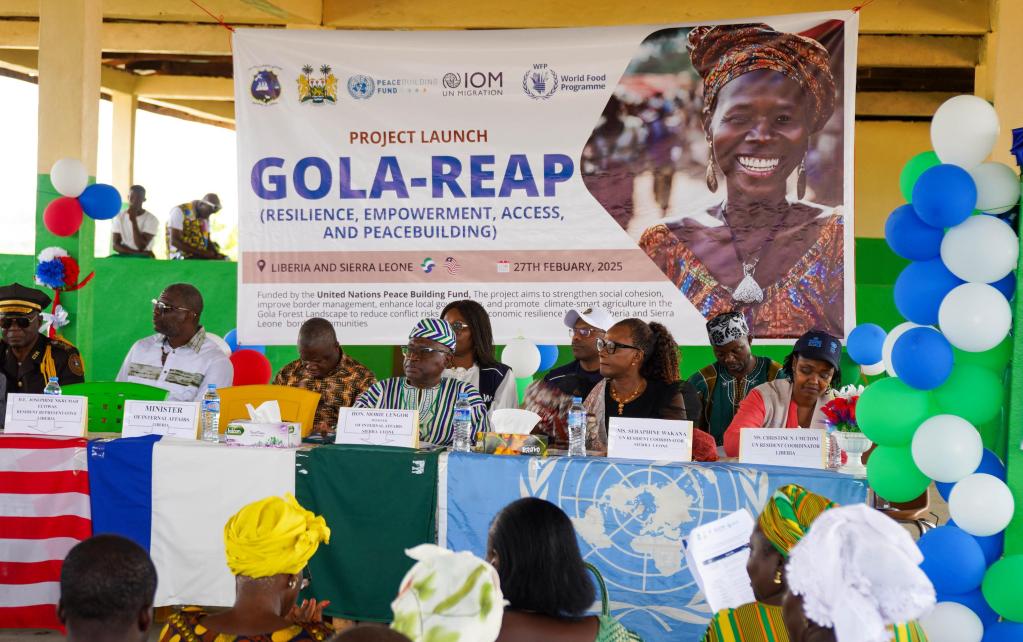
UN, in Collaboration with the Governments of Liberia and Sierra Leone, Launches Cross-Border Peacebuilding Project in Gola Forest Landscape
Yesterday the governments of Liberia and Sierra Leone, in collaboration with the UN representations in both countries, officially launched the GOLA-REAP (Resilience, Empowerment, Access, and Peacebuilding) project at Bo Waterside, Liberia. The event brought together government officials, representatives of the UN in Liberia and Sierra Leone, the Mano River Union Secretariat, local authorities, civil society organizations, and community representatives to enhance peacebuilding, sustainable livelihoods, and cross-border cooperation along the Liberia-Sierra Leone border.The GOLA-REAP project aims to strengthen social cohesion, improve border management, enhance local governance, and promote climate-smart agriculture as a means to mitigate conflict risks and foster economic resilience in the Gola Forest Landscape, a protected ecosystem shared between Liberia and Sierra Leone that supports biodiversity, livelihoods, and cross-border trade. Recognizing the need for deepened cross-border collaboration, GOLA-REAP is supported by the United Nations Secretary-General’s Peacebuilding Fund (PBF), the UN's leading financial instrument to invest in prevention and peacebuilding. The Fund supports joint UN responses to address critical peacebuilding opportunities, connecting development, humanitarian, human rights and peacebuilding initiatives. The Honourable Morie Lengor, Minister of Internal Affairs in Sierra Leone, linked the project’s planned activities in border communities to national development. "[Sierra Leone’s] 5 Big Game Changers and Feed Salone initiatives are more than just projects—they are a call to action for our communities to take ownership of sustainable resource management. By strengthening cross-border collaboration, we are fostering peace, resilience, and economic empowerment for the people of Sierra Leone and Liberia."Seraphine Wakana, UN Resident Coordinator for Sierra Leone, opened her statement by thanking the Government of Liberia for hosting the event and commenting on the importance of the area. “Grand Cape Mount County plays a crucial role in regional peacebuilding efforts, crucial for the development of both countries,” she said. “The boundary between Sierra Leone and Liberia means you have a shared past, a shared present and a shared future, a future you are dedicating efforts towards making it better. Importantly, the boundary means shared peace.”Implementation of GOLA-REAP will be jointly led by the International Organization for Migration (IOM) and the World Food Programme (WFP) in both countries, in partnership with national governments and in collaboration with local authorities, community representatives, civil society organizations, and regional institutions such as the Mano River Union (MRU). The project has already garnered support from key policymakers and peace advocates, who have highlighted the critical importance of this geographical area for sustained peace, security, and resilience in both countries and the potential of the project to prevent conflicts and sustain the peace in the region.Edward K. Mulbah, Deputy Minister for Research and Development Planning in Liberia, emphasized resilience. “The Gola Forest is a shared heritage and a pillar of peace, security, and economic resilience between our two nations. This is a testament to our commitment to sustainable development and regional cooperation."The GOLA-REAP project builds on the PBF cross-border peacebuilding efforts implemented between 2021-2024 in Sierra Leone and Guinea, in which WFP and IOM supported governments to strengthen civil institutions and evidence-based policies for conflict resolution and peaceful co-existence between cattle herders and crop farmers in border regions of the two countries.By enhancing collaboration and trust between local communities, forest rangers, border authorities, and national governments, the project aims to enable the prevention and peaceful resolution of community conflicts while advancing sustainable resource management in this important region.“Through GOLA-REAP, we have a unique opportunity to make the Gola Forest a lasting legacy—not just as a protected area, but as a model of cross-border peacebuilding, cooperation, and shared prosperity,” said UN Resident Coordinator for Liberia Christine N. Umutoni. “Let us seize this moment, work together, and turn our shared vision into reality.”The RC’s comments reinforced the themes of conservation and prosperity that were present throughout the session’s remarks from both high-level partners and community members."This forest is our heritage,” shared Lawrence V. Sherbo, Commissioner of Liberia’s Kongba District, during the event’s opening statements. “We must protect it for generations to come.” For more information, please contact:In Monrovia, Serge Lenaud: slenaud@iom.int In Freetown, Sam Whitlow: rwhitlow@iom.int
1 of 5
Story
08 April 2025
From Tradition to Transformation: The Sonkay Town Vocational and Heritage Center
"It was not easy at the beginning, when I opened the school by myself," recalls Massa Kandakai, her voice carrying the weight of her journey. "But I know it was worth it. I saw the need for change in our community, and someone had to take the first step."In the heart of Todee District in a rural part of Liberia, a remarkable transformation is taking place. Massa Kandakai, once a practitioner of Female Genital Mutilation (FGM), has become a pioneer for change in her community. Her journey from traditional practices to becoming an advocate for alternative livelihoods exemplifies the power of education and economic empowerment in creating sustainable cultural shifts. A Leader's JourneyMassa Kandakai's decision to abandon FGM practices didn't come easily in a country where the procedure affects 38.2% of women aged 15-49. As a respected Zoe (traditional leader), her choice to establish a school in Sonkay Town[DM1] represented a significant departure from deeply entrenched cultural norms."When we first introduced this initiative, many women in the surrounding villages were hesitant to participate," Kandakai recalled during a recent visit by international dignitaries. "However, as they learned new skills, gained financial independence, and saw the positive changes in their lives, their perception shifted."Today, that school has evolved into the Sonkay Town Vocational and Heritage Center (VHC), a facility that offers alternative livelihoods for former FGM practitioners, education for at-risk girls, and alternative cultural heritage preservation for surrounding communities. Currently, 94 children—mostly girls—are enrolled in the school, receiving an education that might otherwise have been inaccessible to them.A Center for ChangeThe Sonkay Town VHC stands as one of four centers funded by the EU/UN Spotlight Initiative to serve as a center of learning and cultural exchange to replace bush schools where FGM was practiced. Constructed between 2020 and 2023 on 35 acres of land, the center serves approximately 400 traditional zoes who were previously involved in FGM, as well as around 1,500 young women and girls from Montserrado County.The center comprises five structures: a multi-purpose hall, a dining hall with kitchen, a six-room training facility including a teacher lounge, an office for the facility's administrator, and a solar panel storage room. But more than its physical infrastructure, the center represents a fundamental shift in cultural practices.During the implementation of the Spotlight Initiative, 127 bush schools were officially closed in Montserrado County following a full ban on FGM. This progress builds on years of engagement with traditional leaders and the Government of Liberia, which led to policy statements in 2019 and 2022 temporarily suspending the practice, culminating in a nationwide ban proclaimed by Chief Zanzan Karwor, former National Chairperson of the Council of Chiefs and Elders of Liberia, on February 6, 2023."Today, the women are not only earning income but also saving and investing in their families' futures," Kandakai explained. "Some of them have even been able to purchase homes for the first time, a milestone that was once unimaginable. Economic empowerment does not benefit only women; it strengthens entire households and communities."International Recognition and SupportOn March 1, 2025, Erica Gerretsen, Director for Human Development, Migration, Governance & Peace at DG INTPA, European Commission, visited the center alongside representatives from the Government of Liberia, the European Union in Liberia, and the UN in Liberia, including RCO Christine N. Umutoni and UN Women Liberia Country Representative, Comfort Lamptey."Since 2016, the European Union, in partnership with the United Nations, has been committed to addressing the issue of Female Genital Mutilation in Liberia through the Spotlight Initiative," Gerretsen noted during her visit. "Standing here today and witnessing the tangible results of this work is both humbling and inspiring."She emphasized the significance of the progress made while acknowledging the challenges ahead: "Liberia has made significant strides in combating FGM, including the signing of a national ban on the practice. However, despite this progress, much remains to be done. The work being carried out at the Sonkay Town Vocational and Heritage Center is proof that change is possible." Liberia's Minister of Gender, Hon. Gbeme Horace-Kollie, who also visited the center, shared similar sentiments: "When we assess the success of a project, we must ask: how has it impacted the lives of those it was designed for? Listening to the testimonies of former FGM practitioners today, hearing how they have been able to rebuild their lives and secure sustainable livelihoods, reaffirms the importance of this initiative."She particularly highlighted Kandakai's leadership: "The Chief Zoe's leadership in establishing this school is particularly inspiring. The transformation of this community is remarkable, and I am immensely proud of what has been achieved. This center stands as an example of how we can empower women and girls by providing them with viable alternatives that preserve cultural heritage while eliminating harm." Looking Forward: Spotlight 2.0The momentum generated by the Sonkay Town VHC and similar initiatives is set to continue with the launch of Spotlight 2.0. On March 4th, Erica Gerretsen joined Liberia's Minister of Planning and Development Planning, Augustine Kpehe Ngafuan, to sign the financing agreements for the Spotlight 2.0 Initiative and the Support Measures of the European Union's Annual Action Plan 2024.This significant step forward ensures that gender equality and sustainable development will continue to be priorities in Liberia. The signing ceremony was attended by the Minister of Gender, Hon. Gbeme Horace-Kollie, UN Resident Coordinator Christine N. Umutoni, representatives from the UN system, and other Government officials.Under Spotlight Initiative 2.0, priority will be given to empowering grassroots women who survive gender-based violence and those transitioning away from FGM. The initiative will provide vocational training in fields like hospitality, beauty services, soap making, weaving, tie-dyeing, climate-smart agriculture, and IT skills. Additional financial literacy programs will equip participants with essential business management skills, encouraging them to join VSLAs for solidarity and growth.Economic empowerment activities will be conducted with local organizations to foster entrepreneurship, and young women will be connected to TVET schools, ensuring that the skills they gain translate into sustainable livelihoods.A Vision for the FutureWhen asked about her hopes for the future, Massa Kandakai's answer was both practical and visionary: she wants a car. Not as a status symbol, but as a tool for expanding the center's impact—so she and the other women could learn to drive and then travel to other communities, reaching even more women to empower them.As Gerretsen observed during her visit, "The Zoes of Sonkay Town should be recognized as role models for change. This center, alive with learning and economic empowerment, is a beacon of hope for the future."In the story of Massa Kandakai and the Sonkay Town Vocational and Heritage Center, we find a powerful testament to the possibility of preserving cultural identity while abandoning harmful practices, and to the transformative potential of education and economic empowerment in creating sustainable, community-led change. [DM1]Establishing a school versus operationalizing the VHC by the opening of a primary school for young women and girls is something we may need to clarify in the narrative.
1 of 5

Story
21 April 2025
Liberia Electoral Support Project Concludes Gender Sensitization Training for Security Sector in Nimba
To promote a safer and more inclusive political environment, the National Elections Commission (NEC), in collaboration with the Organization for Women and Children (OROWCH), the United Nations Development Programme (UNDP) and UN Women, concluded a two-day training on gender sensitization and awareness aimed at preventing and responding to violence against women in elections and politics (VAWE/P). The training, held on April 14 and 15 in Ganta, brought together over 60 participants, including members of the Liberia National Police, local security institutions, representatives from the Project Accountable Safe Space Women’s Accountability Room (PASSWAR) across various magisterial areas, by-election monitors, and civil society actors. Aligned with Sustainable Development Goal 5, which focuses on gender equality and women's empowerment, and Goal 16, which emphasizes Peace, Justice, and Strong Institutions, the training addresses the systemic issues of electoral violence. It supports the NEC in fulfilling its constitutional mandate to plan, manage and conduct elections pursuant to national laws, international standards, and best practices, in partnership with other electoral stakeholders, such as the Liberia National Police and civil society, with a strong emphasis on inclusivity. Randolph Dennis, Deputy Commissioner of the Liberia National Police, remarked, "This training is a step forward in our journey to ensure that gender equality is not just a policy but a practice in every aspect of policing. I encourage all participants to embrace the lessons learned and apply them daily, especially in serving our communities with respect and inclusivity." Assistant Commissioner of Police Teta Wilson, Chief of Gender Affairs Section of the Liberia National Police and Public Relations Officer, Liberia Female Law Enforcement Association (LIFLE) encouraged members to recognize and build upon their internal strengths. The training also served as a networking platform for the Liberia Female Law Enforcement Association (LIFLEA), fostering collective advocacy for increased representation and advancement within the ranks of the Liberia National Police. Leisel Telary, Director of the Gender Unit at the NEC, highlighted the Protocol between the National Elections Commission and registered political parties to address Violence against Women in Elections and Politics (VAWE/P). She explained that the Protocol—an electoral code of conduct designed to guide political parties’ actions during the electoral process—underscores the need for an effective referral pathway for survivors of VAWE/P and a stronger role for security institutions in preventing politically motivated violence against women.Topics covered included the types and root causes of VAWE/P, relevant national and international legal frameworks, and the roles of key actors in responding to electoral violence. The sessions were designed to build local accountability, promote inclusive practices, and enhance early response mechanisms. The UNDP Liberia Electoral Support Project (LESP) is co-funded by the European Union, Irish Aid the Embassy of Sweden and UNDP, and implemented in partnership with the NEC, UN Women and the Netherlands Institute for Multi-Party Democracy. It aims to strengthen national institutions and processes in promoting a more inclusive, participatory, and accountable democracy in Liberia.
1 of 5

Story
11 December 2025
FAO Director-General Launches Two Major Agriculture Initiatives in Liberia
The Director-General of the Food and Agriculture Organization of the United Nations (FAO), Dr. Qu Dongyu, today launched two flagship initiatives—the Hand-in-Hand Initiative and the One Country, One Priority Product (OCOP) programme—at a ceremony held in Monrovia. As part of the OCOP launch, Liberia has officially selected Coffea Liberica as its priority commodity.The introduction of these initiatives marks a significant step forward in advancing Liberia’s agricultural transformation agenda. Coffea Liberica, a rare coffee species indigenous to Liberia, was chosen for its exceptional characteristics and strong potential in the international specialty coffee market. With this selection, Liberia becomes the first African nation to introduce a coffee product under the OCOP framework.Speaking at the launch, Dr. Qu emphasized the importance of the moment for the country’s food systems:
“This is an important moment for Liberia’s agrifood transformation. Our focus is on real, measurable results — and farmers are at the heart of this change.”Liberia’s Minister of Agriculture, Dr. J. Alexander Nuetah, welcomed the partnership and highlighted the broader economic opportunity it presents:
“We thank FAO for the collaboration. Coffea Liberica will drive new jobs, attract investment, and become a symbol of innovation and economic empowerment for Liberians.”Through the Hand-in-Hand Initiative and OCOP, Liberia aims to:Strengthen climate-resilient agricultureIncrease productivity and market competitivenessExpand agribusiness opportunities and job creationEnhance its position in the global specialty coffee marketThe launch underscores the growing collaboration between FAO and the Government of Liberia and reaffirms a shared commitment to making agriculture a driver of inclusive and sustainable national development. FAO Director-General Meets President Boakai, Reinforces Support to Liberia’s Agricultural Transformation President Joseph Nyuma Boakai, Sr. today met with the Director-General of the Food and Agriculture Organization of the United Nations (FAO), Mr. Qu Dongyu, at the Executive Mansion for high-level discussions aimed at accelerating Liberia’s agricultural modernization agenda.The FAO Director-General was accompanied by a senior delegation including Deputy Director-General Mr. Godfrey Magwenzi, Chief Economist Dr. Maximo Torero, Assistant Director-General Dr. Abebe Haile Gabriel, Mr. Yang Hau, Ms. Lineo Molise, and Mr. Hong Shen. FAO Liberia representatives and the UN Resident Coordinator, Christine .N. Umutoni , were also present. President Boakai welcomed the delegation and expressed appreciation for FAO’s longstanding partnership with Liberia, emphasizing his administration’s commitment to unlocking the country’s vast agricultural potential. He underscored that Liberia is now ready to “harvest what has been planted over the years,” with a renewed focus on modernization, commercialization, and ensuring national food security.Mr. Qu commended Liberia’s renewed drive toward agricultural development, noting the country’s rich natural endowments, including the distinctive Liberica coffee variety with strong global market potential. He reaffirmed FAO’s commitment to strengthening technical and financial cooperation with Liberia, particularly in enhancing value chains, boosting farmer resilience, and promoting youth engagement in agriculture.The Director-General also highlighted opportunities for expanded collaboration through China’s Academy for Tropical Agricultural Sciences (CATAS), which can support research, training, and technology transfer to enhance productivity and innovation across Liberia’s agricultural sector.Mr. Qu reiterated FAO’s readiness to support Liberia’s priorities in seed systems development, climate-smart agriculture, and expanding market access for local commodities.President Boakai thanked the Director-General and his team for their continued support and reaffirmed the Government’s commitment to working closely with FAO and development partners to ensure agriculture becomes a key driver of economic growth and national prosperity.The FAO DG also met with UN Country during his visit.
“This is an important moment for Liberia’s agrifood transformation. Our focus is on real, measurable results — and farmers are at the heart of this change.”Liberia’s Minister of Agriculture, Dr. J. Alexander Nuetah, welcomed the partnership and highlighted the broader economic opportunity it presents:
“We thank FAO for the collaboration. Coffea Liberica will drive new jobs, attract investment, and become a symbol of innovation and economic empowerment for Liberians.”Through the Hand-in-Hand Initiative and OCOP, Liberia aims to:Strengthen climate-resilient agricultureIncrease productivity and market competitivenessExpand agribusiness opportunities and job creationEnhance its position in the global specialty coffee marketThe launch underscores the growing collaboration between FAO and the Government of Liberia and reaffirms a shared commitment to making agriculture a driver of inclusive and sustainable national development. FAO Director-General Meets President Boakai, Reinforces Support to Liberia’s Agricultural Transformation President Joseph Nyuma Boakai, Sr. today met with the Director-General of the Food and Agriculture Organization of the United Nations (FAO), Mr. Qu Dongyu, at the Executive Mansion for high-level discussions aimed at accelerating Liberia’s agricultural modernization agenda.The FAO Director-General was accompanied by a senior delegation including Deputy Director-General Mr. Godfrey Magwenzi, Chief Economist Dr. Maximo Torero, Assistant Director-General Dr. Abebe Haile Gabriel, Mr. Yang Hau, Ms. Lineo Molise, and Mr. Hong Shen. FAO Liberia representatives and the UN Resident Coordinator, Christine .N. Umutoni , were also present. President Boakai welcomed the delegation and expressed appreciation for FAO’s longstanding partnership with Liberia, emphasizing his administration’s commitment to unlocking the country’s vast agricultural potential. He underscored that Liberia is now ready to “harvest what has been planted over the years,” with a renewed focus on modernization, commercialization, and ensuring national food security.Mr. Qu commended Liberia’s renewed drive toward agricultural development, noting the country’s rich natural endowments, including the distinctive Liberica coffee variety with strong global market potential. He reaffirmed FAO’s commitment to strengthening technical and financial cooperation with Liberia, particularly in enhancing value chains, boosting farmer resilience, and promoting youth engagement in agriculture.The Director-General also highlighted opportunities for expanded collaboration through China’s Academy for Tropical Agricultural Sciences (CATAS), which can support research, training, and technology transfer to enhance productivity and innovation across Liberia’s agricultural sector.Mr. Qu reiterated FAO’s readiness to support Liberia’s priorities in seed systems development, climate-smart agriculture, and expanding market access for local commodities.President Boakai thanked the Director-General and his team for their continued support and reaffirmed the Government’s commitment to working closely with FAO and development partners to ensure agriculture becomes a key driver of economic growth and national prosperity.The FAO DG also met with UN Country during his visit.
1 of 5

Story
10 December 2025
UNFPA and UNICEF Sanitary Pads Initiative Is making a Breakthrough in Keeping Girls in Schools in Rivercess County.
"We can now stay in school during menstruation," says 19-year-old Grace Togar, a 12th-grade student at Green Passion School System in Cestos City, Rivercess County. Grace heads the Adolescent Girls Advisory Panel, an advocacy group of adolescent girls responsible to advocate for participation and leadership in Rivercess County. Speaking at an engagement meeting with UNFPA Resident Representative Dr. Mady Biaye, during his field mission to Rivercess, Grace expressed deep gratitude for UNICEF and UNFPA's support with the provision of sanitary pads in schools. The provision of sanitary pads is part of a wider support to comprehensive sexuality education (CSE) in schools and includes the establishment and support of 20 school health clubs in Rivercess County. Prior to the programme, as Grace noted, girls would leave school when their menstruation began, with many of them not returning due to the distances of their homes. Grace added that menstruation was a source of discomfort and shame, rarely discussed, which led to high absenteeism particularly among adolescent girls. "Back then, you did not want your period to start on campus because you do not have pads to change after cleaning yourself, and boys would tend to bully you too," Grace recounted.Decontee Paye, Guidance Counselor at Cestos High School also in Rivercess County, confirmed the situation highlighted by Grace: "Prior to the inception of UNFPA and UNICEF Comprehensive Sexuality Education activity... absenteeism among adolescent girls was common... at Cestos High School where I work, most girls were absent during recess period because most of the girls would go home on the excuse that their menstruation had started."Left to Right: Decontee Paye, Grace Togar, Titus Ponnie, Theresa G. Dixon and Michael Bondo shared their perspectives on the impact of UNFPA-sponsored CSE activity in Rivercess County. ©UNFPA Liberia/George Y. SharpeWhile the availability of pads has brought immediate relief, Ms. Paye highlighted the broader impact of CSE. School-going adolescents in Rivercess now have a higher understanding of menstrual hygiene management and are eager to share this knowledge with their peers. Furthermore, CSE has fostered crucial discussions on family planning's role in preventing teenage pregnancy and STIs—a major step toward reducing Rivercess's high teenage pregnancy rate of 55 percent. Ms. Paye noted that CSE counseling significantly dispelled myths that family planning causes infection and reproductive health disorders.The programme has also fundamentally changed the social environment. Theresa G. Dixon, an 18-year-old 11th grader at the Green Passion School System, emphasized that CSE is vital not only for preventing teenage pregnancy but also for reducing the risk of infections (from wearing one pad for too long) and, importantly, reducing bullying.The shift is particularly evident among boys. Titus Ponnie, an 18-year-old 11th grader male student at Cestos High School, recalled that previously, boys would be embarrassed to discuss menstrual health, and some would "laugh at the girls and bully them when we notice that they are bleeding." Now, with the help of CSE, Titus says boys are comfortable discussing menstruation with girls and understand that involving boys is essential for reducing teenage pregnancy. To sustain the programme's success, Josephine Kaye of Yarpah Town Public School called for improved Water, Sanitation, and Hygiene (WASH) facilities. "If we must sustain the progress made in terms of increased knowledge, we need to increase access to clean water and have decent washrooms for all students, particularly girls," she urged, noting that supportive school environments are crucial for improved menstrual health.Josephine Kay (standing on the left) of Yarpah Town Public School speaks to UNFPA about the impact of CSE activity in her school, stressing the need to sustain the progress. ©UNFPA Liberia/George Y. SharpeMichael Bondo, UNFPA Programme Analyst working in Rivercess County, stated that the CSE programme is a critical strategy for tackling the county's high school attrition rate. While progress has been seen with the empowerment of adolescents, boys and girls, Michael sees the need for continued awareness with parents in homes and communities to build on this success. “UNFPA's strategy involves strengthening school health clubs to facilitate peer-to-peer CSE, linking them to youth friendly centers in health facilities, and connecting them to the general community to ensure improved Sexual and Reproductive Health and Rights (SRHR) outcomes. The role of parents and community leaders in this process cannot be overstated”, Michael adds.This story of change from Rivercess County represents early signs of success of the Nurture, Empower, and Protect (NEP) Joint Programme for adolescent girls SRHR and Nutrition in collaboration with UNICEF with funding from the Embassy of Ireland. As part of this programme, UNFPA will support the Ministry of Education to deploy sanitary pad banks in 200 schools in Montserrado, Grand Gedeh, and Rivercess Counties.
1 of 5

Story
10 December 2025
16 days of Activism- Students and Young People Speak up Against Digital Violence
On Tuesday, December 9, 2025, the One UN in Liberia and the University of Liberia joined forces to mark the #16DaysOfActivism Against Gender-Based Violence at UL’s Fendall Campus, calling for urgent action to end violence in both physical and digital spaces. The event brought together students, government representatives, civil society, the private sector, and the UN in Liberia to address violence against women and girls in both physical and digital spaces. Speaking at the event, Comfort Lamptey, UN in Liberia Resident Coordinator a.i. and UN Women Liberia Country Representative, warned that Liberia recorded 3,957 GBV cases in 2024, including 2,759 rapes, and by Q3 2025 had documented 1,735 rapes. With 1.8 million Liberians now online, she stressed that digital abuse—cyberbullying, harassment, and image-based violence—is rising and called for collective action to create safer online environments. UL Vice President Weade Kobbah Boley announced new academic programs, including a Master’s in Artificial Intelligence and graduate degrees in Cybersecurity and Gender Studies in partnership with @UNDPLiberia, reinforcing UL’s commitment to digital innovation and safety. Speaking on behalf of the Ministry of Gender, Children & Social Protection, Director Bennietta Jarbo Jartoe said gender-based violence remains at the center of the Ministry’s work. She highlighted the increasing rate of online abuse, stressing that both physical and digital violence must be confronted with equal urgency. Delivering remarks on behalf of the Ministry of Posts and Telecommunications, Lusenii G. Sando, Director of Telecommunication, stressed the government’s efforts to strengthen national cybersecurity frameworks, including the Cybercrime Act of 2021 and the Data Protection Bill now before the Legislature. The event featured exhibitions, digital literacy sessions, and youth-led discussions, underscoring Liberia’s commitment to ending all forms of violence and empowering young people in an increasingly digital world. Together, we can make Liberia’s digital space safe for all.
1 of 5

Story
01 December 2025
Liberia Marks World AIDS Day 2025 - Driving Domestic Action for a Sustainable HIV Response
Liberia joined the global community on Monday, December 1, to commemorate World AIDS Day 2025, reaffirming its commitment to ending AIDS and building a resilient HIV response under the global theme “Overcoming Disruption, Transforming the AIDS Response” and a local theme “Mobilizing Domestic Support, Transforming the AIDS Response.On behalf of the United Nations, UNDP reiterated its support for Liberia in advancing a sustainable, inclusive, and resilient HIV response. Speaking on behalf of the UN Resident Coordinator, Christine Umotoni, UNDP Resident Representative Mr. Aliou M. Dia highlighted Liberia’s remarkable progress over the past decade.He noted that new HIV infections have declined by 69 percent since 2010, while treatment coverage among those who know their status now exceeds 98 percent. This achievement has contributed to a 74 percent reduction in AIDS-related deaths.Mr. Dia also emphasized that communities continue to lead innovative approaches to prevention, care, and support, underscoring their critical role in sustaining progress and driving the national HIV response forward.“These achievements reflect strong government leadership, community engagement, and the unwavering support of national and international partners,” he said.Despite these gains, Liberia faces persistent challenges of service delivery disruptions, funding gaps, stigma and discrimination, and inequalities in access. Dia emphasized that sustainability is key, and Liberia’s HIV response cannot rely solely on external funding.The UNDP Resident Representative stressed that priority actions should focus on mobilizing domestic resources to ensure sustainable funding for prevention, treatment, and social support; strengthening health systems to deliver integrated services for HIV, TB, and other health priorities; empowering communities to lead and sustain solutions as the backbone of progress; and embracing innovation and partnerships to provide cost-effective interventions and equitable access for all. He expressed gratitude to development partners, NGOs, civil society, and donors for their continued support. The recent Global Fund replenishment of US$11.34 billion toward its US$18 billion target for 2026–2029 underscores global solidarity in ending AIDS.Dr. Cecelia Nuta, Chairperson of the National AIDS Commission, reaffirmed that HIV is no longer a death sentence, stating, “People living with HIV can work, thrive, and contribute to national development. We must ensure that stigma and discrimination do not undo the progress we have achieved over the years.”She also emphasized the critical role of community leadership in sustaining Liberia’s HIV response.Dr. Jonathan Flomo, Program Manager of the National AIDS and STI Control Program (NACP), highlighted the importance of knowing one’s HIV status and accessing treatment. Flomo noted that pregnant women are now routinely tested for HIV and syphilis, ensuring early care for mothers and children.Call to ActionStakeholders were urged to take action to sustain Liberia’s HIV response. Legislators are encouraged to prioritize HIV in national budgets and enact policies that protect the rights of all, especially the most vulnerable.The private sector is called upon to create inclusive workplaces, support health insurance schemes, and invest in innovations that strengthen the health system.Young people are recognized as key actors in achieving an AIDS-free future, with their leadership, voices, and innovation essential to sustaining progress.Together, we can achieve an AIDS-free Liberia—ensuring dignity, rights, and access for all.
1 of 5

Story
12 November 2025
“My Body Is Not on the Menu” Four Adolescent Girls Rewrite Their Future in New Kru Town
A young woman enters the hospitality classroom at the Centre for Adolescents in New Kru Town amidst a roar of excitement. She looks like a star returning home with her radiant smile and confident stride, instantly lighting up the room. Cheers erupt from the students: “Leticia!” Her former teacher, busy explaining how to welcome guests, turns around to embrace her warmly, and the class gathers around, inspired by the young woman who once sat where they now sit.Leticia is a proud graduate of the Let Us Learn (LUL) programme in New Kru Town, a UNICEF-supported initiative that equips vulnerable youth with life skills and vocational training. Before starting the programme, Leticia lived in an abusive household. “We were used for money. My aunt did not pay for school. If we refused what the men wanted, we were beaten”. At just 14 years old, Leticia was already exposed to violence, exploitation and experienced an unwanted pregnancy.“I felt stuck,” she says.Adolescent stories likeLeticia’s are not unique. Social worker Rachel tells us how violence and exploitation are common around New Kru Town, a community known to have harsh living conditions. “Many children are self-reared. At ages six or seven, they are already working. Between 10-12, they are getting into crime and substance abuse or even conflicts with the law. Girls turn to the street and become commercial sex workers.”Half of the adolescents enrolled in the LUL programme are teenage mothers.The community's reputation, offering a life with no control, attracts young people from all over Montserrado County. “They want freedom from rules and end up findingviolence, prostitution and crime. Once they get here, they quickly adapt,” she explains.“If we sit there and think that they will take it upon themselves to change their life, it won’t happen”.Programmes like the Let Us Learn with support from UNICEF are giving young boys and girls an opportunity to build their trade and vocational skills, so that they make better choices about their futures- ones they can be proud of.For Leticia, things started to change when she met a counsellor at the centre. With guidance and a grant, she pushed back against her exploiters and started a small business. After moving out on her own, she joined the life skills programme.“They (the LUL programme) gave us an opportunity, and real support, including food and transportation. They took us seriously.”Students like Leticia were motivated when interacting withsupportive adults while acquiring new skills. From a social aspect, it's where friendships were built to hold one another accountable and focused.As Leticia sits beside her friend Grace, she recalls the most difficult moments of her adolescence.Grace lived with her grandmother, who sold coal and was rarely home. After school, she would follow friends to the streets. They said it would be fun.“On the street, I saw nothing I liked. I saw prostitution, drinking, and smoking.”She soon started taking substances, drinking alcohol and eating poorly. “It was killing me slowly.”Grace was sent home from the programme three times. “They said I was not in the best shape.” But I did not give up.” On her third try, one of the programme's social workers saw her determination. “She is serious. We can have her.”For adolescents at LUL, Counselling is the cornerstone to them building their confidence, facing theirdecisions and charting a way forward in a comfortable environment.Like an emergency room, it stabilizes the emotions before we start treating the deeply rooted problems. Social worker Rachel explains:“Adolescents arrive with fear, trauma, and no emotional support. But even then, when they come here, they may not want to be here; they have a hard time focusing, and they want to escape. They have disturbing behaviours, so we are patient. It may take up to a year to go through the programme”.She adds how she often reaches into her own personal experiences to connect with them.The programme runs in stages: counselling before life-skills, then vocational skills ahead of a three-month internship. If they perform well,they’re hired.Today, 375 adolescents are enrolled, and thousands have been empowered in this community and across Liberia with the extension of the programme to Margibi and Grand Bassa Counties.The centre is now in a brand-new, welcoming location to provide refuge and the safe space adolescents need. It has expanded the number of classes available to provide marketable skills and attract more boys.“The girls come more easily. The boys are harder – they’re deep into crime. Explains Social Worker Rachel.In the nearby plumbing shed, is Alexander, Benjamin, Esther & Esther – both former sex workers and teenage mothers. Their friendship is a lifeline. “She helped me gain confidence to share my thoughts,” Esther says.Beyond the training and counselling, it’s perhaps these relationships, the camaraderie and the peer support that make the programme truly transformative.Grace now works as a housekeeper at an expat compound and earns enough to support herself and her mother, who joined her from Nimba County. “If it wasn’t for the programme, I don’t think I’d be here today” glancing at Leticia, she adds, “She is my best friend. We call each other often; we tell each other to be strong.”Today, Leticia works at a popular club in Monrovia, where she was recently promoted to a cashier. “When I was waitressing one evening, a man offered me $150 for the night. I remembered my teacher’s words when he talked about the downside of the jobs in hospitality: ‘Know your worth.’ And I thought of Grace, too, who always tells me to be strong. So, I said to him: “My body is not on the menu.”Her courage did not go unnoticed. Management praised her integrity and asked where she had trained. “I told them I didn’t come from a trade school. I came from a vocational programme in the slums”. Impressed, they promoted her.Leticia lives independently, earns a stable income, and mentor’s others. For many of Liberia’s youth, Let Us Learn is more than just a programme. It’s a launchpad for dreams, where hope is restored, dignity reclaimed, and futures rewritten one adolescent at a time.As Leticia and Grace leave the centre together, Leticia’s words to the community’s adolescents linger:“The life you are living out there is not the life you want to live. I know it does not define you.”
1 of 5

Press Release
17 December 2025
National Peace Hut Election
Women Peacebuilders Elect New National Peace Hut Leadership in Transparent and Peaceful ProcessTotota, Bong County — 13 December 2025. Women members of Peace Huts from across all 15 counties gathered at the Totota Peace Hut in Bong County to elect a new National Peace Hut Leadership, marking the first leadership renewal since 2019. The election represents an important milestone in strengthening women-led peacebuilding, community mediation, and social cohesion across Liberia.The initiative was supported by the Governments of Ireland and Sweden, with technical and logistical assistance from UN Women Liberia; in collaboration with the Ministry of Gender, Children and Social Protection (MGCSP), Women NGO Secretariat of Liberia, and Association of Female Lawyers of Liberia, the election brought together Peace Hut representatives to reinforce democratic governance, accountability, and inclusive leadership within the network. The process also served as an opportunity to further popularize the newly developed Standard Operating Procedure (SOP), with the support of the United Nations Peacebuilding Fund that will guide Peace Hut operations across the country.The newly elected leaders are: Madam Velma P. Sajery (President), Madam Esther Dolo (Vice President), Madam Mamie Varjolo (Secretary), Madam Hawa Isango (Financial Secretary), and Madam Annie Y. Merchant (Chaplain).Independent observer Krubo Flomo, Social Worker at MGCSP Bong County, commended the peaceful conduct of the polls:“The Ministry’s role was not only to observe but to encourage women to see leadership as service to their communities. The election was peaceful and transparent, and when the results were announced, everyone celebrated with joy — even candidates who did not win.”D. Mulbah K’anglai, who served as Chair of the Election Commission, emphasized the commitment of Peace Hut members to credible and inclusive leadership:“I witnessed firsthand how peaceful and transparent the process was. The new leadership will move the organization forward by embracing new ideas and encouraging Peace Hut women to advance collectively.”In addition to the election, participants took part in structured orientation and capacity-building sessions focused on democratic leadership and internal governance. The induction prepared the newly elected leaders for their roles, strengthened accountability within the network, and supported smooth leadership transition and coordination at national and county levels. The sessions also helped familiarize participants with the Peace Hut Standard Operating Procedures, developed with support from the United Nations Peacebuilding Fund, which will guide Peace Hut operations nationwide.For more than a decade, Peace Huts have played a critical role in preventing and mediating community conflict, supporting survivors of violence, and advancing women’s participation in peacebuilding, local governance and political processes. Renewing leadership ensures the network remains effective, unified, and aligned with its mission of community-driven peacebuilding and women’s leadership.UN Women Liberia remains committed to supporting Peace Huts through technical, logistical, and communication assistance, and to strengthening women’s leadership and community resilience throughout Liberia.
1 of 5
Press Release
17 December 2025
Women Peacebuilding Leadership Election
Women Peacebuilders Elect New National Peace Hut Leadership in Transparent and Peaceful ProcessTotota, Bong County — 13 December 2025. Women members of Peace Huts from across all 15 counties gathered at the Totota Peace Hut in Bong County to elect a new National Peace Hut Leadership, marking the first leadership renewal since 2019. The election represents an important milestone in strengthening women-led peacebuilding, community mediation, and social cohesion across Liberia.The initiative was supported by the Governments of Ireland and Sweden, with technical and logistical assistance from UN Women Liberia; in collaboration with the Ministry of Gender, Children and Social Protection (MGCSP), Women NGO Secretariat of Liberia, and Association of Female Lawyers of Liberia, the election brought together Peace Hut representatives to reinforce democratic governance, accountability, and inclusive leadership within the network. The process also served as an opportunity to further popularize the newly developed Standard Operating Procedure (SOP), with the support of the United Nations Peacebuilding Fund that will guide Peace Hut operations across the country.The newly elected leaders are: Madam Velma P. Sajery (President), Madam Esther Dolo (Vice President), Madam Mamie Varjolo (Secretary), Madam Hawa Isango (Financial Secretary), and Madam Annie Y. Merchant (Chaplain).Independent observer Krubo Flomo, Social Worker at MGCSP Bong County, commended the peaceful conduct of the polls:“The Ministry’s role was not only to observe but to encourage women to see leadership as service to their communities. The election was peaceful and transparent, and when the results were announced, everyone celebrated with joy — even candidates who did not win.”D. Mulbah K’anglai, who served as Chair of the Election Commission, emphasized the commitment of Peace Hut members to credible and inclusive leadership:“I witnessed firsthand how peaceful and transparent the process was. The new leadership will move the organization forward by embracing new ideas and encouraging Peace Hut women to advance collectively.”In addition to the election, participants took part in structured orientation and capacity-building sessions focused on democratic leadership and internal governance. The induction prepared the newly elected leaders for their roles, strengthened accountability within the network, and supported smooth leadership transition and coordination at national and county levels. The sessions also helped familiarize participants with the Peace Hut Standard Operating Procedures, developed with support from the United Nations Peacebuilding Fund, which will guide Peace Hut operations nationwide.For more than a decade, Peace Huts have played a critical role in preventing and mediating community conflict, supporting survivors of violence, and advancing women’s participation in peacebuilding, local governance and political processes. Renewing leadership ensures the network remains effective, unified, and aligned with its mission of community-driven peacebuilding and women’s leadership.UN Women Liberia remains committed to supporting Peace Huts through technical, logistical, and communication assistance, and to strengthening women’s leadership and community resilience throughout Liberia.
1 of 5
Press Release
20 October 2025
Onboarding Training Launched to Establish County Development Planning Units in South-eastern Counties (Grand Gedeh, River Gee, Sinoe, Maryland, and Grand Kru Counties)
The Ministry of Internal Affairs (MIA), with support from the Government of Liberia through counterpart funding to the Liberia Decentralization Support Programme (LDSP) managed by the United Nations Development Programme (UNDP), and from the United Nations Peacebuilding Fund (PBF) through UN Women under the project “Empowering Citizens and Communities to Foster Social Accountability and Transparency in Governance and Public Service Delivery,” launched a five-day onboarding training to establish County Development Planning Units in five south-eastern counties - Grand Gedeh, River Gee, Maryland, Grand Kru and Sinoe. Held in Zwedru from 20–24 October 2025, the exercise convened 70 County Development Planning Officers, along with County Officials, Heads of MACs, and facilitators from the Ministry of Internal Affairs, Governance Commission, Internal Audit Agency, and the Ministry of Finance and Development Planning (MFDP). Several local technicians also participated. The event aimed to advance the implementation of the Local Government Act of 2018 under the theme “Building a New Liberia through Decentralization.”Opening the workshop, Hon. Selena Polson Mappy, Deputy Minister for Operations, MIA, called the establishment of County Development Planning Units “a landmark step toward strengthening local governance and ensuring citizens experience the real benefits of decentralization,” noting that the units will serve as the technical arm of county administrations, linking local priorities to national planning and monitoring frameworks.Hon. D. Emmanuel Wheinyue, Assistant Minister for Research and Development Planning, MIA, explained that each County Development Planning Unit will consist of five key technical roles: Development Planning Officer, Project Engineer, Data Analyst, Monitoring and Evaluation Officer, and Gender and Social Inclusion Officer. He emphasized that “these units will bridge the gap between local development aspirations and the Government’s national agenda by promoting participatory and accountable planning.”The event also featured statements from the Governance Commission and the MFDP, underscoring coordination, transparency and accountability in county development planning. Mr. D. Emmanuel Williams II, Director of Public Service Investment Programs at the MFDP described County Development Agendas as “practical roadmaps that connect national policy with community-level needs,” emphasizing that the success of decentralization depends on the functionality and effectiveness of the new units.Mrs. Oretha T. Lah-Bangurah, Programme Support Officer, UN Women, expressed appreciation for the strong partnership with the Ministry of Internal Affairs and commended the Government of Liberia for its leadership in rolling out the LGA. “Decentralization is not only about structures or systems; it is about people,” she said. “It ensures that every voice, particularly those of women, youth and marginalized groups, is heard and reflected in development decisions that shape their lives.” She added that UN Women’s support through the PBF project aligns with its commitment to inclusive and gender-responsive governance.Delivering remarks on behalf of UNDP, Mr. Eric Boykai, Interim National Program Coordinator of the Liberia Decentralization Support Programme emphasized that County Development Planning Units are the link between national vision and county-level action and encouraged participants to use the week’s tools and templates to translate local priorities into implementable projects with clear responsibilities and timelines. He further concluded that the County Development Planning Units play a critical role in advancing local governance by formulating inclusive, evidence-based development plans aligned with national priorities. They also serve as a vital link between local and central government to ensure coordinated aid and resource alignment, while monitoring development activities to promote transparency, accountability, and effective service delivery.Across the week, facilitators from the MIA, the MFDP, the Governance Commission, the Internal Audit Agency Unit at the Ministry of Internal Affairs, and the Ministry of Gender, Children and Social Protection are guiding modules on inclusive planning methods, Public Sector Investment Programme, developing concept notes and proposal templates, programme budgeting, internal audit and compliance, monitoring and evaluation, and gender-responsive planning and budgeting, among others. Sessions combine presentations with group work and practical use of standard templates so county teams leave with draft materials they can refine and adopt through their administrations.The onboarding in Zwedru is the final step in achieving the legal requirement for all 15 counties to establish County Development Planning Units in Liberia.
1 of 5
Press Release
21 April 2025
Joint Statement by International Partners on the Nimba by election
The International Community remains committed to supporting Liberia's democratic journey. As Nimba heads to the by election on April 22, 2025, we encourage all stakeholders to abide by the terms of the Farmington River Declaration and all relevant laws to foster a credible, free, fair, inclusive and peaceful electoral process. The International Community commends the National Elections Commission, the Liberia National Police and all security agencies for the work done so far and urges all institutions to remain impartial to build confidence in a credible and successful electoral process. Finally, the International Community urges all citizens to play their role in forging further democratic gains in Liberia.
1 of 5
Press Release
16 April 2025
Liberia Convenes Government and Development Partners Retreat to Bolster National Development Plan Implementation
FOR IMMEDIATE RELEASE Monrovia, Liberia- The Government of Liberia will host the inaugural Government and Development Partners Retreat (GDPR) on Thursday, April 17, at EJ S Ministerial Complex, under the theme: “Strengthening Partnerships for the Implementation of Liberia’s National Plan – AAID.”This high-level forum comes at a defining moment in Liberia’s development journey. After more than two decades of peace and democratic progress, the country is charting a bold course toward inclusive and transformative growth through its new National Development Plan (NDP) 2025–2029, known as the Arrest Agenda for Inclusive Development (AAID).The Government and Development Partners Retreat serves as a strategic platform to strengthen partnerships, align priorities, and explore innovative funding models that support AAID and Liberia’s broader Sustainable Development Goals (SDGs). It will also highlight the Country Development Agendas (CDAs)—newly endorsed planning instruments guiding national and subnational development priorities.According to a Ministry of Finance and Development Planning release, at the end of the retreat, the government and its partners expect stronger coordination and innovative financing solutions.The GDPR will bring together a wide range of national and international stakeholders, including: Senior representatives from the Government of Liberia, including ministers and heads of institutions, bilateral and multilateral development partners, Ambassadors, and heads of cooperation, representatives from the United Nations, international financial institutions, and the private sector, civil society organizations, youth groups, NGOs, academia, and policy think tanks.With an estimated financing requirement of $8.3 billion, the AAID aims to transition Liberia from a low-income to a lower-middle-income country. While 30% of this funding is expected to come from domestic resources, the remaining gap requires robust external support and innovative financing solutions. This comes at a time when the development financing landscape is becoming increasingly uncertain, with reduced donor funding, changing global priorities, and limited private sector engagement.This retreat underscores the Government of Liberia’s commitment to inclusive and collaborative governance, as well as its resolve to work hand-in-hand with partners to realize the country’s development aspirations.
1 of 5
Latest Resources
1 / 11

Resources
16 December 2025


1 / 11
